
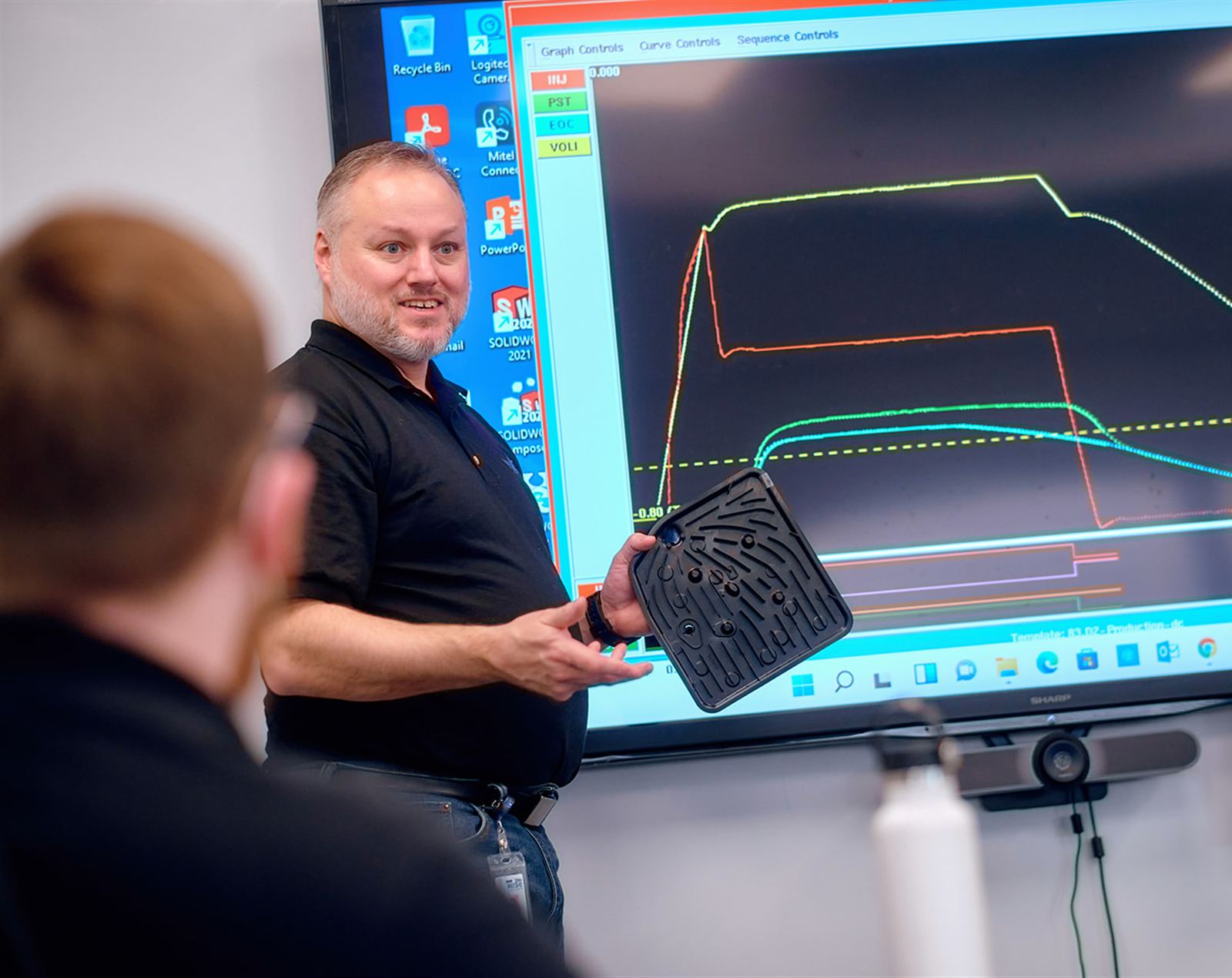
The most expensive problems in injection molding are not molding problems. They are design decisions — made months before a molder ever sees the part — that quietly harden into tooling steel, cycle time, and per-part cost. Early Supplier Involvement (ESI) is the practice of bringing your contract molder into the conversation at the CAD or concept stage, and it has one of the clearest returns on investment in product development.
The cost-of-change curve is not your friend
Product development has a well-known rule of thumb: the cost of an engineering change grows by roughly an order of magnitude at each stage it survives. A wall-section change that costs a conversation at the concept stage becomes a CAD revision at the design stage, a steel modification at the tooling stage, and a re-validation plus scrapped inventory at the production stage.
| Stage discovered | What a moldability fix typically costs |
|---|---|
| Concept / CAD | A design review and a CAD revision |
| Tool design | Redrawn tool layout, days of schedule |
| After first shots (T1) | Steel changes — welding or recutting, weeks of schedule |
| Production | Steel changes plus re-qualification, scrapped parts, line-down risk |
Every experienced molder has seen the same handful of issues ride that curve all the way down: sink marks over thick bosses, warp from uneven wall sections, a gate location chosen by default that puts a weld line across a cosmetic surface, an undercut that demands a lifter nobody budgeted for. None of these are exotic. All of them are visible — to a molder — in the CAD, before steel.
Where the money actually hides
1. Wall sections and ribs
Uniform, appropriately thin walls fill predictably, cool evenly, and cycle fast. Thick-to-thin transitions cause sink, voids, and warp — and the “fix” after tooling is usually a compromise: slower cycles, process gymnastics, or cosmetic concessions. Caught at CAD, it is a fillet and a core-out.
2. Draft and undercuts
Missing draft and unintentional undercuts are the classic tooling-cost multipliers. Each undercut that survives to tool design adds a slide or lifter — more steel, more maintenance, more things that wear. A molder reviewing concept CAD will flag where one degree of draft or a small geometry change deletes an entire mechanism from your tool.
3. Gate location and weld lines
Where the plastic enters the part decides where it knits back together. Weld lines are a strength and cosmetics issue, and gate location is nearly free to change in CAD — and painful to change in steel. Moldflow simulation answers this before tooling; we run it as standard on new tooling programs so fill, warp, and gate questions get settled in software.
4. Material selection
Resin choice ripples through everything: shrink (and therefore tool dimensions), tolerances, cycle time, and piece price. Engineering a part around a resin that is over-specified wastes money on every shot; under-specifying finds out in the field. An early conversation about end-use environment, regulatory requirements, and volumes lets the material drive the design — not retrofit it.
5. Tolerances that match the process
Drawings inherited from machined-part thinking often carry tolerances injection molding cannot hold — or can hold only with 100% inspection. A molder will tell you which dimensions are critical-to-function and which can relax, trading inspection cost for nothing but a drawing note.
6. Part consolidation
The biggest wins are sometimes additive: two parts and an assembly step become one molded part; a fastener becomes a snap fit; a label becomes in-mold decoration. These opportunities only surface when someone who thinks in mold cavities looks at your assembly early.
What ESI looks like in practice
Early Supplier Involvement is not a committee or a contract — it is a working session. You bring CAD in whatever state it exists, expected volumes, and the part’s job description. The molder brings process knowledge and tooling experience. The output is concrete: a design-for-manufacturing review with specific geometry recommendations, material candidates with trade-offs, a realistic tolerance conversation, and — before any steel is cut — moldflow results showing how the part will actually fill.
Done at the right time, this work compresses instead of extends your schedule. The T1-samples-then-rework loop is where molding programs lose their launch dates; a part that was designed to mold from day one tends to sample well, qualify on plan, and leave the process window wide enough for stable scientific molding for the life of the program.
The ROI, framed honestly
We will not pretend there is a universal multiplier, but the structure of the return is consistent across programs:
- Avoided steel changes. One prevented post-T1 modification typically pays for every hour of early engineering involvement, several times over.
- Schedule protected. Steel changes are measured in weeks. Launch slips are measured in lost revenue.
- Permanently lower piece price. Faster cycles, fewer cavity mechanisms, right-sized material, and relaxed non-critical tolerances compound on every part, for the life of the program — often millions of shots.
- A tool that ages well. Simpler tools with fewer mechanisms cost less to maintain and survive more cycles before refurbishment.
The cost side of the ledger is a few meetings and a willingness to share CAD early. That asymmetry is the whole argument.
Already past the design stage?
ESI is ideal, but it is not all-or-nothing. If your tooling already exists and the program is underperforming, the same engineering review applies in reverse — we do it routinely as part of tooling transfers, where transferred molds get a documented condition assessment, moldflow validation, and a scientific molding process developed from data rather than inherited setup sheets.
Either way, the principle holds: the earlier a molder’s eyes are on the part, the cheaper every problem is to fix. Send us what you have — CAD, prints, or a concept sketch — and we will tell you what we see.