
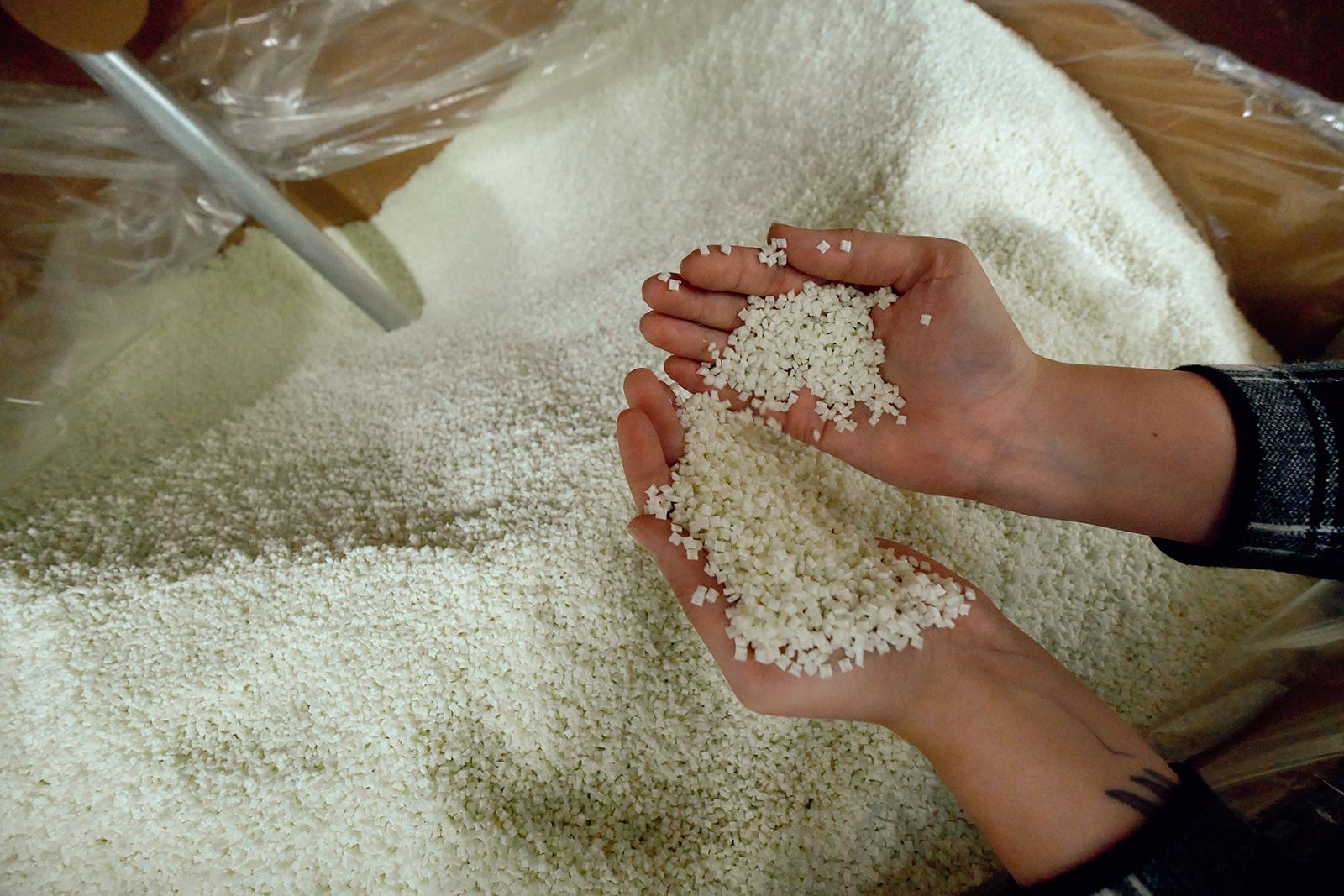
Most material selections fail by default, not by analysis — somebody specs the resin from the last project and moves on. The right thermoplastic is rarely the strongest or the most exotic one. It is the cheapest material that survives the environment for the life of the part. Here is how a molder actually narrows the field.
The master split: amorphous vs semi-crystalline
Before any datasheet comparison, every common thermoplastic falls on one side of a single structural divide, and that divide predicts most of its behavior in the press and in service.
- Amorphous resins — ABS, polycarbonate, PC/ABS — have a random molecular structure. They soften gradually, shrink little and uniformly, and hold tight, stable dimensions with good cosmetic surfaces. They paint and bond well. The trade: chemical resistance is mediocre, and under stress plus the wrong solvent they crack.
- Semi-crystalline resins — polypropylene, nylon, acetal — form ordered crystal regions with a sharp melting point. They shrink more and less predictably, so warp and tolerance control take more work. In exchange you get genuine chemical resistance, low friction, and the fatigue endurance that lets a hinge flex a million times.
A widely used first cut: cosmetic housings and tight-tolerance enclosures point amorphous; anything facing chemicals, wear, or repeated flexing points semi-crystalline. Get this split right and you have already eliminated half the candidates.
The usual suspects
Seven materials cover the overwhelming majority of custom-molded parts. Know their personalities and you can shortlist in minutes.
| Resin | Reach for it when | Watch out for |
|---|---|---|
| ABS | Tough cosmetic housings; paintable, platable, low cost | UV degradation outdoors; weak against solvents and fuels |
| Polycarbonate | High impact, optical clarity, higher service heat | Environmental stress cracking with many chemicals and cleaners; notch sensitivity |
| PC/ABS | Housings needing more impact and heat than ABS at less cost than PC | Blend ratios vary by grade — verify properties, don't assume |
| Nylon 6 and 6/6 | Wear surfaces, gears, under-hood heat, chemical exposure | Moisture absorption shifts dimensions and toughness; must be dried before molding |
| Polypropylene | Chemical resistance, living hinges, lowest cost per part | Cold-temperature brittleness, creep under load, hard to paint or bond |
| Acetal (POM) | Low-friction sliding parts, springy snap fits, gears and latches | Difficult to bond or paint; poor UV and acid resistance; high shrink |
| TPE / TPU | Grips, seals, strain reliefs, soft-touch overmolds | Compression set and creep vary widely by grade; specify hardness and environment |
Two notes from the molding floor. Nylon's relationship with water deserves respect: it absorbs moisture in service, growing slightly and trading stiffness for toughness as it conditions — and resin that isn't dried before molding degrades in the barrel and ships weak parts that looked fine at first article. And on the flexible end, when a TPE grade runs out of temperature or biocompatibility headroom — gaskets in autoclaved devices, for instance — the conversation usually moves to liquid silicone rubber, which is a different process with different tooling.
The axes that actually decide it
Datasheets list dozens of properties. In practice, a handful of questions do the deciding:
- Operating temperature — continuous service temperature, not the peak the part sees for ten seconds. Check both, and check them under load.
- Chemicals and cleaners — including the ones nobody puts on the drawing. Hospital disinfectants kill more polycarbonate housings than drops do. List everything the part will touch, then check stress-crack data, not just immersion data.
- UV exposure — outdoor service eliminates unstabilized ABS and PP fast. UV-stabilized grades and carbon black exist; spec them deliberately.
- Impact — and at what temperature — many resins that shrug off a drop at room temperature shatter at freezer temperatures. PP is the classic example.
- Flex and fatigue — a living hinge is a polypropylene feature, full stop. Snap fits that cycle constantly favor acetal's springiness.
- Regulatory — FDA food-contact compliance, UL flammability ratings, and biocompatibility for medical devices are grade-level properties, not polymer-level ones. The certificate belongs to the specific grade, and substitutions reset the clock.
- Cost per part, not per pound — the number on the resin quote misleads. Density sets how many parts a pound buys: PP is cheap per pound and light, a double win. Cycle time matters just as much — a resin that needs long cooling or extensive drying costs machine hours that never show up on the material line.
Work the axes in that order and most applications collapse to two or three candidate grades — and grades matter. "Nylon 6/6" is a family, not a specification. Lock the exact grade on the print, because impact modifiers, stabilizer packages, and regulatory certifications all live at the grade level, and a casual substitution can quietly change every one of them.
Glass fiber: stiffness with strings attached
When the neat polymer runs out of stiffness, creep resistance, or heat deflection, glass fill is the standard lever — 13 to 40 percent loadings can multiply stiffness several times and sharply improve dimensional stability under sustained load. But fibers orient with flow. The part shrinks less along flow than across it, and that anisotropy is the engine of warp in glass-filled parts. Glass is also abrasive, so gates, runners, and cavities want hardened steel, and surface finish takes a visible hit. This is exactly why we run moldflow simulation as standard on new tooling programs: fiber orientation and warp are predictable before steel is cut, and gate placement can steer them.
Material and design are one decision
Here is the part that selection guides usually skip: the resin and the geometry are not separate choices. Nominal wall thickness, rib ratios, and radii that work in ABS will sink and warp in acetal; a snap fit sized for nylon's conditioned toughness will snap off in dry PC. If you change the material, re-run the DFM fundamentals against the new shrink and stiffness — every time.
The cheapest place to settle all of this is before the tool is quoted. Our engineering team does material trade studies as part of design review, backed by moldflow on new tooling and a quality lab that can prove the dimensions once a grade is locked. If you are weighing two or three candidate resins and want a molder's read on which one survives your environment at the lowest piece price, send us the application details — the conversation is free, and it is a lot cheaper than re-cutting steel for resin number two.